Cataracts: understanding your options
Ángeles Gómez interviews Pablo Artal in La Vanguardia · 27 September 2026.
Read the interview (Spanish) ↗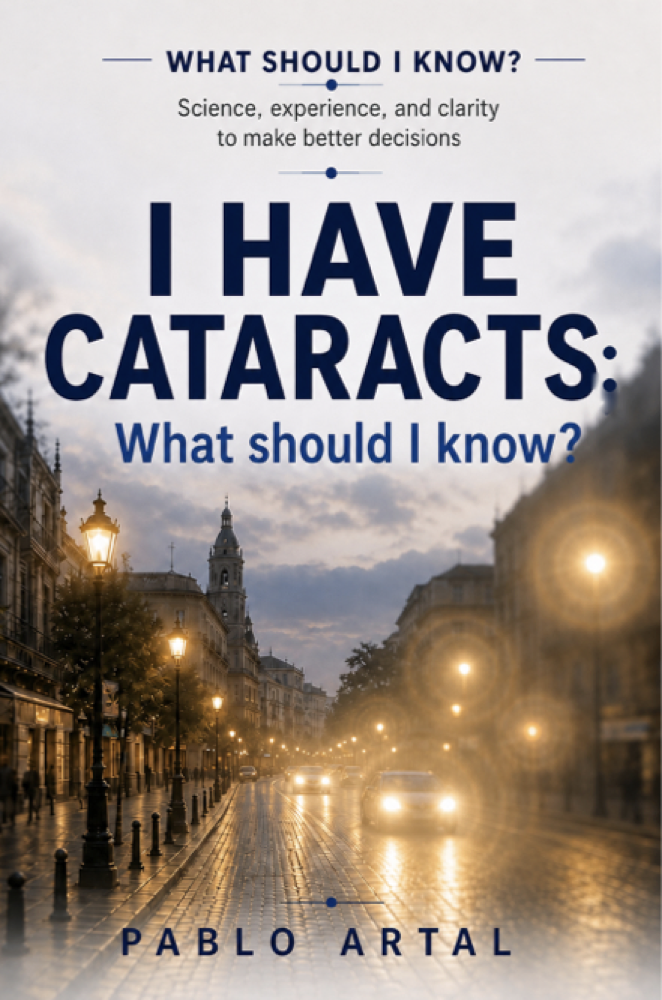
English edition
WHAT SHOULD I KNOW? SERIES
From diagnosis to recovery: a guide to understanding the options and bringing better questions to your ophthalmologist.
This edition is available for pre-order. Downloads begin on the stated release date; the Kindle ebook remains on Amazon.
Free resource
Download and print this checklist, bring your questions and write down your ophthalmologist’s answers. Space for your notes is included.
Download the free PDF3 pages · Large print · No registration or email required
You are welcome to share the PDF with family and others who may find it useful.
Ten questions before cataract surgery · View the checklist and how to use it
SCIENCE, EXPERIENCE AND CLARITY
This book is for people diagnosed with cataracts, anyone considering surgery and family members who want to help. No background in medicine or optics is needed: ideas are introduced step by step, with examples and illustrations.
24 chapters in six parts. Open each part to see its chapters and the questions it explores.
What cataracts are, why they develop, how they affect vision and the questions behind deciding when to have surgery.
From the history of cataract surgery to today’s procedure and the role of lasers: understanding what is done and why.
The heart of the book: visual goals, lens designs, astigmatism, peripheral vision, halos and image quality.
Measurements, the characteristics of each eye, choosing a surgeon and discussing realistic expectations before the procedure.
The day of surgery, the first few weeks, secondary cataract and the difficulties that may arise when the result is not as expected.
Ten ideas to organise what you have learned and prepare for an informed conversation with your specialist.
The book also includes the author’s introduction, a declaration of interests, a brief glossary and further reading.
The opening of Chapter 1. An extract to give you a feel for the book’s voice.
1. What Exactly Are Cataracts?
To understand cataracts, you need to know only a few things about the eye and how it works. Do not worry: I am not going to give you a lesson on the optics of the eye. For the purposes of this book, its basic operation can be understood quite simply.
To see, we first need to form a good image of the outside world on the retina, a thin layer of nerve tissue containing light-sensitive cells at the back of the eye. From there, information travels to the brain, where it is interpreted and ultimately produces our perception of the world.
From an optical standpoint, the eye is surprisingly simple. It contains two elements that act as lenses: the cornea and the crystalline lens.

Pablo Artal is Professor of Optics and founder of the Optics Laboratory at the University of Murcia, Spain. His research explores how the eye forms images and what limits visual quality. The book brings that experience to questions that arise at an eye appointment, distinguishing scientific knowledge from opinions and personal expectations.
Meet the author ↗The book includes a declaration of interests. Pablo Artal explains his involvement in Voptica and the development of ArtIOLs intraocular lenses, and the experience behind his discussion of different options. This gives readers context about his relationship with technologies discussed in the book.
Interviews exploring the questions behind the book and its approach to explaining science. Both interviews are in Spanish.
Ángeles Gómez interviews Pablo Artal in La Vanguardia · 27 September 2026.
Read the interview (Spanish) ↗A La Verdad interview about science, curiosity and Pablo Artal’s books · 6 September 2026.
Read the interview (Spanish) ↗Cataracts are a clouding of the eye’s natural lens. They can cause blurry vision, glare and difficulty seeing in low light; an eye examination helps establish how much they contribute to your symptoms.
The decision depends on how cataracts affect your activities and your ophthalmologist’s assessment. There is usually time to decide; updated glasses or better lighting may help in the meantime.
No single option suits everyone. Discuss your activities, eye health, expectations about glasses and possible differences in contrast, halos and glare.
You may. This depends on the lens, the refractive result and the distance at which you want to see; no option guarantees freedom from glasses in every situation.
General information to help you prepare for a conversation with your ophthalmologist; it does not replace an individual assessment.
Sources: National Eye Institute · American Academy of Ophthalmology. Reviewed November 1, 2026.
For a fuller explanation, explore the book’s contents and read a sample. Explore the book and sample.
No. The book is written for general readers. A short glossary helps explain terms you may encounter in the book or during an appointment.
It explains differences, advantages and limitations so you can understand the alternatives and ask questions. It does not select a lens for an individual case or replace your ophthalmologist’s assessment.
Yes. It is also for people supporting someone with cataracts who want to understand the diagnosis, decisions and recovery.
Alongside this English edition, there are editions in Spanish, German and Brazilian Portuguese. Each edition page lists its available formats and retailers.
The English edition is available as a Kindle ebook, paperback and audiobook. Links to each format appear at the top and bottom of this page.
Each link takes you to the listing for that format. Please check the retailer for current prices and availability.
You can also ask your bookseller about the paperback edition, distributed through IngramSpark. ISBN: 979-13-992928-1-7.
Pablo Artal · English · Artal Books · What Should I Know? series
Kostenlose Checkliste: zehn Fragen vor der Operation des Grauen Stars
Das deutsche E-Book »Grauer Star: Was sollte ich wissen?« ist jetzt bei Amazon Kindle, Apple Books, Smashwords und Barnes & Noble erhältlich. Bei Amazon.de kaufen ↗ Barnes & Noble · E-Book ↗
Apple Books · Deutsch ↗Free Brazilian Portuguese checklist. The Portuguese ebook is now available on Amazon Brazil, Apple Books and Barnes & Noble.
Amazon Kindle · Português ↗Apple Books · Português ↗